Artificial Intelligence is changing the workforce, and STEM education must evolve with it.
Artificial Intelligence (AI) is no longer a futuristic concept — it's an everyday reality, shaping how we live, learn, and work. From smart infrastructure to medical diagnostics and digital communication, AI-driven systems now influence nearly every major industry.
As automation accelerates and the nature of work evolves, one truth is undeniable: students who understand technology will lead it; those who don't will be led by it.
That's why the convergence of AI and STEM education represents one of the most important shifts in modern learning — and why proactive educational leaders are acting now.
The impact of AI on the U.S. workforce is profound. A McKinsey Global Institute (2023) report estimates that by 2030, up to 30% of current U.S. work hours could be automated, and as many as 12 million workers may need to transition into new roles that require digital literacy, problem-solving, and data fluency.
At the same time, new opportunities are emerging. The National Science Foundation (NSF) projects exponential growth in fields like machine learning, robotics, and computational engineering — all requiring STEM foundations strengthened by early exposure to AI principles.
AI integration isn't about replacing human thinking — it's about amplifying it. According to the MIT Sloan Management Review (2024), tomorrow's roles will “combine human judgment, creativity, and empathy with technical skills to collaborate with AI systems effectively.” This hybrid skill set starts in the classroom.
That's why leading districts and state initiatives are incorporating AI literacy into K–12 STEM pathways. Programs like AI4K12 (supported by the National Science Foundation and the Association for the Advancement of Artificial Intelligence) have created national frameworks to teach AI fundamentals — from recognizing intelligent behavior to understanding data ethics and algorithmic bias.
Yet, despite this momentum, a majority of U.S. schools still lack practical tools to teach AI concepts. According to a 2024 Education Week Research Center survey, “only 18% of K–12 teachers say they feel adequately equipped to introduce AI-related topics.” The gap isn't about interest — it's about resources, training, and access.
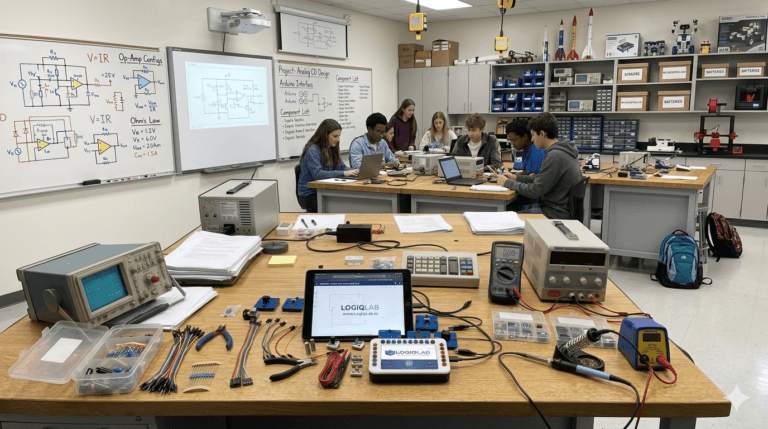
That's where solutions like LogiqLab step in — bridging theoretical knowledge with hands-on application. LogiqLab combines STEM fundamentals with AI-powered experimentation, enabling students to explore how algorithms interact with sensors, data, and physical hardware.
Each LogiqLab kit includes:
- Smart hardware modules that simulate real engineering and automation systems.
- Integrated software that visualizes signals, processes data, and demonstrates how machines “learn” and react.
- Curriculum frameworks designed by educators and engineers to teach not just the what of technology — but the why behind it.
This complete ecosystem empowers teachers to guide students through the same design, test, and refine cycle that drives real-world innovation.
“AI literacy will soon be as fundamental as reading, writing, and arithmetic.”
LogiqLab embodies that philosophy. By integrating AI with practical STEM exploration, it transforms classrooms into incubators for creativity and problem-solving — preparing students to become not just technology users, but innovators, inventors, and leaders in the AI age.
The future isn't waiting. It's already here — and LogiqLab helps students meet it with confidence.