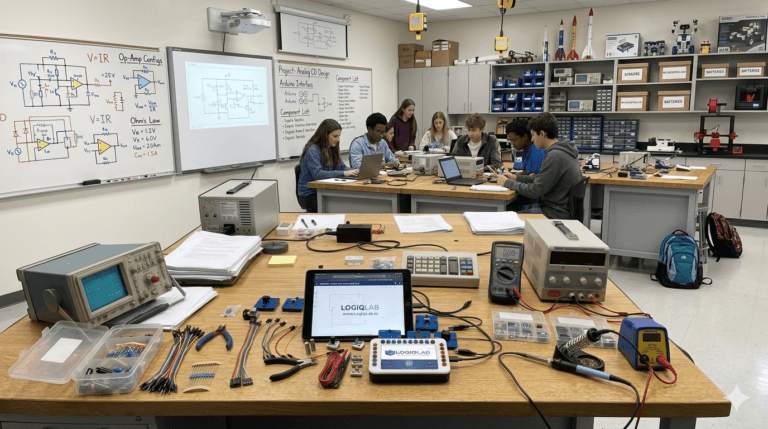
Turning policy vision into classroom reality begins with bold leadership.
Every superintendent, county supervisor, and state education director shares the same challenge: how to deliver measurable progress in education while preparing students for the realities of tomorrow's workforce.
STEM implementation has become one of the most effective strategies to achieve that. It's not just about introducing new subjects; it's about reshaping how students learn, how teachers teach, and how communities grow.
Districts that have embraced applied, hands-on STEM learning aren't just improving test scores — they're revitalizing local economies, building stronger teacher pipelines, and earning national recognition for innovation.
The Measurable Impact of STEM Adoption
According to the National Science Board's “STEM Education of the Future” report (2024), districts that integrate hands-on STEM labs see up to a 35% increase in student engagement and significant improvements in problem-solving and collaboration skills across grades 7–12.
But the benefits extend far beyond classrooms. States like California, North Carolina, and Ohio have reported measurable community outcomes after large-scale STEM program rollouts:
- Higher graduation rates (an average 8% increase in districts with STEM academies).
- Expanded teacher retention, as educators gain access to modern tools and professional development.
- Increased local business partnerships, with companies supporting classroom labs, mentorships, and internships.
A 2023 Education Commission of the States brief concluded that “every $1 invested in local STEM programs yields between $4 and $7 in economic returns over 10 years,” through improved workforce participation and regional competitiveness.
Local Models of Success
One standout example comes from Riverside County, CA, where a collaboration between the county's Office of Education and the California STEM Network transformed traditional science classrooms into technology-rich maker spaces. The county documented:
- A 47% rise in students choosing STEM electives.
- A 25% uptick in AP Science enrollment.
- A doubling of local business-education partnerships within 18 months.
Similarly, North Carolina's STEM East Network connected schools with regional industries such as advanced manufacturing and biomedicine, producing thousands of internships and improving local hiring rates.
These examples prove that policy-driven STEM implementation works — when supported by practical tools and scalable systems.
Expert Perspective
“STEM is not an education initiative; it's an economic one. When you invest in STEM at the local level, you're investing in long-term prosperity, civic innovation, and workforce resilience.”
For districts and states, this means the responsibility — and opportunity — lies in how effectively they translate STEM policy into daily classroom practice. That's where LogiqLab turns strategy into reality.
Designed for school districts, technical programs, and CTE pathways, LogiqLab provides a turnkey STEM implementation system that eliminates barriers to hands-on learning:
- Hardware: Plug-and-play lab kits with sensors, microcontrollers, and electronics modules.
- Software: Virtual instruments that simulate real engineering and science tools for analysis, testing, and data visualization.
- Curriculum: Project-based lessons aligned to NGSS and CTE standards — complete with assessments, teacher guides, and extension projects.
This integration means administrators don't have to piece together multiple vendors or platforms. Everything is unified — making district-wide STEM adoption simpler, faster, and demonstrably effective.
“Hands-on, technology-enabled learning environments give students the confidence to apply classroom theory to real-world problems — that's where innovation begins.”
With LogiqLab, schools move beyond experimentation into application. Students design, test, and refine projects the same way engineers do. Districts collect measurable outcomes. Communities witness the results.
If your county or state is exploring a scalable STEM initiative, LogiqLab can help design and implement a model that fits your region's goals. Get in touch to learn how.