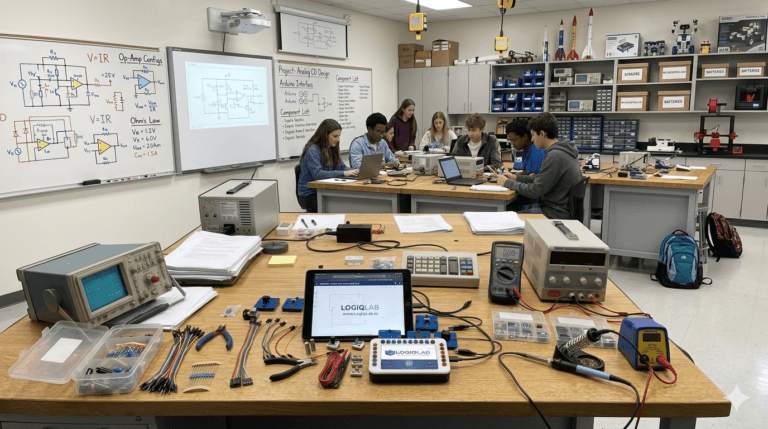
Building stronger communities begins with stronger STEM programs.
From the assembly line to the space station, America's success has always been powered by innovation — and innovation begins with STEM education.
As industries transform under automation, digitalization, and advanced manufacturing, the workforce of tomorrow depends on our ability to equip students today with the skills that fuel economic progress.
For regional leaders, school districts, and policymakers, STEM education isn't just an academic initiative — it's an economic strategy.
The National Workforce Shift
According to the National Science Foundation's 2024 Science & Engineering Indicators, more than 36.8 million Americans — roughly 24% of the U.S. workforce — hold STEM-related jobs, and that number is projected to increase by another 10 million within the next decade. These jobs are not confined to Silicon Valley or high-tech sectors; they exist across manufacturing, healthcare, logistics, and public infrastructure.
In 2024, the U.S. Bureau of Labor Statistics identified STEM occupations as growing nearly twice as fast as non-STEM roles, with median salaries roughly 67% higher than the national average. That's a signal to every region: the communities that prioritize STEM will attract industries that pay well, stay long, and strengthen local economies.
Beyond the Buzzwords: Real-World Impact
This growth isn't just about coding or robotics. STEM thinking — experimentation, data-driven problem-solving, and systems design — underpins virtually every modern job.
A Brookings Institution report titled “Improving Workforce Development and STEM Education to Preserve America's Innovation Edge” found that regions investing in strong K-12 STEM programs see measurable returns: higher per-capita income, increased business investment, and stronger public-private partnerships in education.
For instance, states such as Texas and North Carolina have introduced statewide “STEM pathways” that connect high school coursework directly to technical apprenticeships and university engineering programs. The result? Higher graduation rates, increased career placements, and a steady pipeline of skilled local talent.
Expert Perspective
“STEM education has become the infrastructure of opportunity. It's the single most reliable predictor of career mobility and economic growth in any region that embraces it.”
When school districts introduce applied STEM learning — where students don't just read about science but do science — they cultivate curiosity, critical thinking, and confidence. Those are the same attributes employers are willing to invest in.
That's precisely the role LogiqLab was built to play. LogiqLab delivers a complete STEM learning ecosystem — combining hardware, software, and curriculum to make hands-on education scalable, affordable, and directly aligned with workforce realities.
Each classroom kit empowers teachers and students to:
- Build and test circuits that mirror real-world engineering principles.
- Use virtual instruments to measure, analyze, and visualize data just as professionals do.
- Follow structured lesson plans designed by engineers and educators to meet national STEM and CTE standards.
This approach transforms students from passive learners into active problem-solvers, ready for the technical, creative, and analytical demands of the modern economy.
“When students experience authentic engineering challenges, they develop persistence and adaptability — the same traits that drive economic resilience.”
By partnering with districts and regions, LogiqLab ensures that every student, regardless of zip code, gains access to the tools and experiences that fuel both personal and community growth.
The result? A local economy prepared for tomorrow — led by the schools and leaders who saw the future coming. If you're ready to explore how a scalable STEM implementation can strengthen your district or county's workforce pipeline, get in touch and we'll share how LogiqLab can help.